Queen’s restored vampire-law regime
The Vampire's Pet: Romantasy at its darkest (Blood and Kisses Chronicles : A Dark, Gothic Romance Series)Queen’s restored vampire-law regime is the authoritarian order that remakes Ichoryllia after the Queen reinstates the Old Vampire Laws. Its significance lies not only in the laws themselves but in the linked institutions and acts of force that make human subordination ordinary: breeding farms and pet shops, the repression of dissent, and a religious transformation that reaches even the royal palace. The regime is presented through Aleksander Dumoulin’s divided perspective. He recognizes signs of corruption and understands the danger of speaking against the Queen, yet welcomes the laws for restoring a social hierarchy he considers natural.
Restoration and the New Order
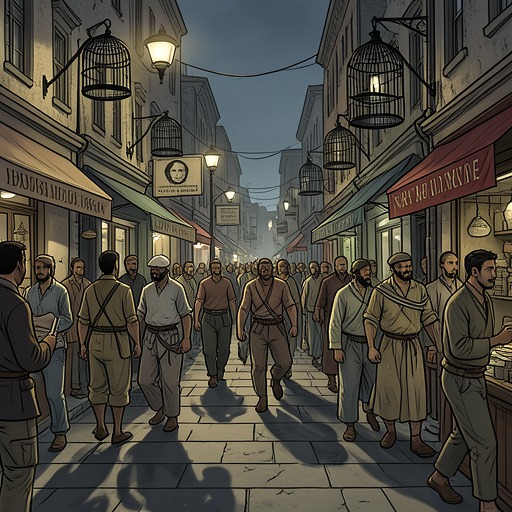
The change is visible in the city almost at once. Where Humans had recently walked the streets and worked in blood banks, Vampires now stroll through a landscape Aleksander finds markedly altered. Human breeding farms open on the same day the Old Vampire Laws are reinstated. The speed of that transition leads him to suspect that the Queen’s move was prepared in advance; he believes an establishment could not appear so quickly without warning. He suspects the Queen is implicated in corruption, but keeps that judgment out of his work for the castle.
The restoration also fractures families. Hybrid families are torn apart, while some Vampires take to the streets in protest. The Queen answers opposition with violence or death, cutting short any prospect of revolution. Aleksander expects the population to settle eventually, a judgment that conveys how he views resistance: not as a challenge likely to undo the order, but as unrest the regime can outlast or crush. Opposition is dangerous not only because the Queen uses force, but because speaking openly against her rule can itself be punishable by death.
Hierarchy, Markets, and Human Captivity
The new order changes how Humans appear in public life: from workers in blood banks to people captured in the city and held for sale. At the Ichoryllia Human Pet Store, Aleksander sees adult captives confined in cages with straw, water, and food scraps; some sleep, while others grip the bars in panic. The owner distinguishes these city-caught adults from the babies produced on the farms. That detail connects the visible trade in captive Humans to a system that also breeds them.
The restoration therefore operates through more than a declaration of law. Captivity becomes a market, and people are sorted and handled as pets. Aleksander selects Esmeralda and buys her accessories, including a black collar set with a large gemstone and a long leather leash. When she hesitates, he orders her to put on the collar and asserts that she belongs to him. His conduct makes the regime’s hierarchy intimate: its assumptions are enacted not only in public policy, but through possession of an individual body. His declaration that nobody touches what is his further exposes how easily protection and ownership become entangled in his view of her.
Ideology and Religious Change
Aleksander’s response prevents the restoration from being read as a simple opposition between a coercive Queen and uniformly resistant Vampires. He knows some Vampires are horrified by the laws and the divisions they create, but he approves of Humans being returned to what he regards as their proper place in the food chain. He says he does not hate them; instead, he treats their subordination as natural and believes they should accept it. His approval reveals how the regime’s hierarchy can be supported by personal conviction as well as imposed by violence.
His response also has a bodily dimension. The old king seemed weak to him, while the new laws awaken an ancient vampiric predatory instinct. Aleksander is uncertain whether his renewed sense of vitality comes from the prospect of capturing prey or from seeing Humans captured in the streets; what matters to him is that he feels alive. This exhilaration sits beside his awareness that the shift may be corrupt, showing that suspicion of how power operates does not necessarily lead him to reject what that power grants him.
The Queen’s authority extends into the palace’s religious imagery. Portraits of Hecate, the mother of Vampires, are replaced with images of Alastor, a demon and spirit of vengeance, while servants repaint rooms and change curtains and chandeliers. Aleksander is not religious, but recognizes the replacement as wrong. He nevertheless treats opposition as too dangerous to voice: the official religion has changed, and resistance to the Queen can carry a death sentence. The remodeled palace thus makes political domination visible as a reordering of both public institutions and symbols.
Limits and Competing Authorities
The regime’s reach forms the political backdrop to Esmeralda’s captivity, but the story also introduces rules and loyalties beyond the Queen’s order. Esmeralda says she grew up in a pack of Werewolf Witches far to the northwest and was born without either a wolf or magic. Her unfamiliarity with Vampires reflects distance between communities that remain at peace but wary of one another; many packs avoid the city or keep only minimal contact. The state’s human-pet system has nevertheless brought her into its marketplace, where Aleksander treats her as a possession.
Later, Esmeralda’s parents identify her as the daughter of Thomas and Alyson, the Alpha and Luna of her pack. Alyson invokes the Luna’s authority when Thomas challenges the choice she makes, while Thomas insists that their daughter’s life is at stake. The dispute then turns on the fated-mate bond: Alyson argues that the Moon Goddess does not observe racial boundaries and that Esmeralda should be with the mate she has chosen. This does not undo the Queen’s laws or establish that the state recognizes such a bond. Instead, it shows that the regime is not the only framework shaping the characters’ lives. Pack authority and sacred kinship can contest the assumptions of a society that classifies Humans as prey and commodities.
Historical Memory and Significance
The restoration is set against the memory of the Dark Times, when the Human population was decimated and brought close to extinction. Aleksander’s mother had taught that Vampires had become civilized and warned him not to repeat their ancestors’ mistakes; his family preferred Blood Wine. His later craving for fresh blood, and his eventual decision to buy a pet, show the gap between that inherited restraint and the appetite encouraged by a society that has again made Humans available for capture.
The regime is therefore marked by a consequential contradiction. It presents human subordination as a return to nature, yet its farms, shops, cages, and coercive enforcement reveal an order actively built and maintained by institutions. Through Aleksander, the narrative shows how such a system can be recognized as politically compromised and still embraced for its privileges and pleasures. Through Esmeralda and her pack, it places that state hierarchy beside other claims of belonging and obligation, without suggesting that either political force or personal attachment makes the regime’s machinery disappear.